Tuesday, March 31, 2009

Late Afternoon, Early Spring


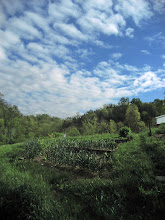
Spring has sprung, and things are waking up. It is amazing to watch the emergence of last year's plants. It never ceases to amaze me when a plant goes dormant in the soil and sits all winter, only to grow tender green shoots again in the spring.

In the picture above, we have black currants, comfrey, strawberries, and valerian (freshly divided into 8 plants, and very wilty).


Things inside the hoophouse are holding up well. This is Melissa, watering some little seedlings with a misting wand. We made a shelf out of bamboo, and have flats of leeks, greens, wildflowers and medicinal herbs.


Here, we planted leeks directly in the ground. So we have leeks in the ground, and leeks in flats. We're trying a few different things as we develop a little production system for leeks. I envision a couple truck loads of leeks in the future!

Above is a work party in April of 2008. We laid out pathways on contour of a gentle slope, dug paths along the contour, and built garden beds right on top of grass.

By the end of the work day, in April '08, we had pathways mulched with wood chips and garden beds made of cardboard and manure. This whole area was grass just a few hours earlier!

The same area, in March '09. The small retaining walls be built at the work party are holding up wonderfully. After a year of adding grass clippings and cover cropping with cowpeas, sunflowers, and a crop of cabbage, we are ready for another summer.
Right now, we have some happy garlic, comfrey, black currants, paw paws, mustard greens, radishes, and peas...and this is only the beginning!
Closeup of the peas, with a trellis ready to support their climb. On the left, we have comfrey planted as a border between the garden area and the grassy hill. Comfrey is one of our most useful plants. We use it with oils and beeswax to make salves for sunburns, wounds, and dry skin. The leaves are dried and used for teas that we drink as well as teas that we spray on gardens. It grows so well, we scythe it 3-4 times in the summer, and use the leaves to mulch the garden below. We try to allow some plants to always be flowering, though, because bees love the purple/blue blossoms.

Friday, March 27, 2009

The Farm: Building a Deer Fence


Just down the road from our hilly homestead, we've rented one acre of nice Elkhorn Creek bottomland from a friend and neighbor. I feel blessed to have access to such a beautiful, flat, and fertile piece of land. This picture shows the beginnings of a deer fence. We're using bamboo instead of buying stakes. There is a large bamboo grove on this farm which the farm owner is coppicing (cutting at ground level) each year.
What will we plant? Lots of cabbage for sauerkraut ("Geier Krauts, LLC"), grains to feed our chickens in the winter, and all the veggies we can plant, weed, water, and harvest.
In this picture, I'm (Brian) talking with Sellus, our newest city commisioner. Sellus is heavily involved in creating community gardens all over downtown Frankfort, and we like to consider our acre a large, country community garden. You can check out the commissioner's website to learn about what's going on in Frankfort, and where Frankfort is headed.

...close-up of a corner post. The farm owner loaned us these great poles to put at the corners of our fence. We'll attach some gates to these as well, so we can open them and drive a truck by the garden to haul in compost or haul out produce. Sellus is keeping his cool with the sunglasses, but he was really bummed that he forgot it was Sunday, and couldn't get beer for us on his way out. As long as we learn from our mistakes...

John and Nathan worked on tying 8 ft. poles to small, stout bamboo poles which we had pounded into the ground with a post driver. Later we'll attach a 7 ft. mesh deer fence.
John is nursing 70 or so strawberry plants at his house that he is going to transplant into this garden. With a small loan from his brother, he will get a taste of what its like to invest, plant, and produce. I hope this garden can be a way for a few of us to get our feet wet with farming that's a lifestyle AND a paying job.

I cannot promise that I will not eat ripe strawberries before John can pick, pack, and sell them. Who could resist?


Kierston and Mike's family came over to help for the day, and Liam had to test the water at the creek. Still a bit too cold for swimming, but it won't be long!


Tuesday, February 24, 2009

At Work: Fresh Harvest in February

I live on Camp Pleasant Road, but on most days, I'm in Frankfort working for Kentucky State University as a research assistant in Organic/Sustainable Vegetable Production. We do a lot of interesting work there, and I can't help but share some of it on this blog. This may not have happened at Camp Pleasant, but some things are related. . .

Last November, as winter was setting in, we took a large portion of our sweet potato harvest and buried it deep in the ground. We had a bit of help from John Clay, a working farmer in his eighties, who claims to be the last colored farmer in Franklin County. (I'm sure that the inevitable BOOM that farming is about to have will change that!) John told us about vegetable storage pits that his parents used to use when he was growing up. Large parts of Kentucky didn't get electricity until the 1950's or so, so many people grew and stored their own food without refrigeration. You can see a video of the construction of our pit on our Kentucky State University Organic Agriculture Working Group website:

http://organic.kysu.edu/FoodStorage.shtml

Just a few days ago, I dug into the soil and found our pit of potatoes and straw. I was amazed. While winter froze and thawed, and dropped inches of snow and ice through December and January, the soil had insulated our pit and preserved a large percentage of our harvest. Below are some pictures.


This is the pit. The blue tarp covered the pit from November to February, and helped keep moisture from getting into the sweet potatoes. The pit is designed to insulate vegetables from freezing, and to keep them in a dry bed of straw or sand.

As you can see, our pit was covered with about 2.5 feet of soil. It is a lot of work to dig into a pit like this...but it is rewarding. Digging into a pit like this is an amazing experience, and it makes it clear why people built root cellars...you only have to dig once!

Clean, dry, live sweet potatoes...


This picture shows the amount of good potatoes and the amount of rotten potatoes. Not bad, if you ask me. Many of the good potatoes had bruises that we had to cut out before cooking. But the taste was everything you'd expect from a sweet potato.
We have about 10X as much as this buried in our pit, and we hope to keep many of them alive until time for replanting in spring!

We also buried temperature-taking probes inside the pit, and we will publish the winter temperatures at different levels in the pit, alongside outside air and soil temperatures, on the KSU Organic Working Group's website.

Wednesday, February 18, 2009

Garden/Farm: The Hoop House is Ready!


Yesterday, I put the finishing touches on our little hoop house. It is made of used lumber from our land, wood from dumpsters, new cattle panel fencing (for the structure), used irrigation tape and hoses, and new plastic.
With this tunnel, we can start seedlings, and extend the season by planting early or planting late. A hoop house collects and traps solar heat. There is nothing heating this house but the sun.

Below are some detailed images for those interested. This entire 10 x 30 tunnel was constructed for about $250.


Inside the house, we've put down a mulch path and a nice layer of compost. The mulch was given to us by the utility company, who dumped huge loads of it on our land when they were trimming trees on our road. The compost is from a company that blends yard "waste" from Lexington with horse manure and straw from thoroughbred farms.

This is a good view of the cattle panels. We used eight of these fence-building panels to build the structure of our tunnel. They were easy to bend, and we simply attached them to large boards that are anchored in the ground a bit by wooden stakes.


We used one large piece of plastic to cover almost all the tunnel. It wraps around the end of the tunnel, where we attached some used irrigation line to the cattle panels to keep the plastic from rubbing on the rough edges of the panels.

Here, you can also see that the plastic is attached by a black line of T-tape...another piece of used irrigation. T-tape is excellent for this. We simply stapled through the T-tape and plastic, and into the wood.


Here's a picture of the wire we used to keep things together. It is super useful
and with a fence tool, you can twist the wire up
and connect just about anything.


This is my favorite part. I had a hard time making the door flush with this design. And any crack lets in a lot of cold air, cooling the tunnel very quickly. With a hoop house, we want to TRAP heat.

Instead of heading to the hardware store, we go to the old barn and hunt for things to use. For this, we found an old hose.


This is a corner of the tunnel. If you look closely, you'll see a little piece of "wiggle wire", which is something used on "real" high tunnels. These pieces were salvaged from a tunnel that was destroyed in a storm.

Wiggle wire allows you to fasten plastic with a wiggly wire into a track. Here, we are using it to secure our roll-up sides. We can remove the wire, making the roll-up side loose, and we can roll it up to the level of the black T-tape to ventilate the tunnel.


See...roll up sides...Inside the plastic is a long pole made from pieces of bamboo tied together with fencing wire. We can roll these sides up and attach them from the inside with little ties.


Trouble shooting...inside the tunnel, we had some gaps where the bamboo poles didn't quite touch the ground. So I plugged these holes with a fun-noodle. Fun noodles were never really that much fun, anyway. Around here, we prefer inner tubes for floating in the river.


...Looking forward to planting leeks, broccoli, and greens!

Please don't hesitate to contact me if you want to chat about this design...

As for high tunnels in general, you can also see a USDA website at:
http://hightunnels.org/

Or the website for Au Naturel Farm at:
http://aunaturelfarm.homestead.com/
Paul and Allison are excellent high tunnel growers in western Kentucky.

Good Foods Coop, in Lexington, are currently looking for a farmer or two to provide lettuce mixes through the winter. "We could sell tons of the stuff...all you could grow..."