Friday, July 22, 2011

appalachian herbalism at camp pleasant

Last weekend we hosted our first publicized herb workshop here at Camp Pleasant Farm. Admittedly, I did little for this effort, since my head is stuck in pickle, kraut, and farm world, but Melissa, together with our friend Andrew Ozinskas from Henry County, pulled off a wonderful day of working with herbs. We had about 20 people attend a 5 hour day complete with fresh lunch.


This blog post is just to share a glimpse of this kind of work that is being done here; it is in no way an attempt to pass on knowledge of herbs or how to process and use them. If you are interested in learning and attending gatherings in the future, don't hesitate to get in touch. We think this was a success and we plan to do more of this kind of workshop in the future. That said, enjoy some pics...


After a little meditation to get us all in the mood, we ventured out into the landscape to look at plants and listen to Andrew. We didn't make it far before we were circled around a plant we all recognize in July, Queen Ann's Lace, which I am sure is known by many herbalists by a more complex and fitting scientific name. If anyone can take a common"weed" and talk for 20 minutes and hold everyone's attention despite a heat index of 100, it is Andrew, who is a young, and frankly brilliant, herbalist. I am honored to have him at Camp Pleasant and I hope we continue to facilitate learning environments with him.

Crossvine, a powerful medicinal which was found and talked about. Each of us in the workshop were encouraged to pick a plant from the landscape and fill a jar with it. Later, when inside, we talked again about each herb and added alcohol to the jar to prepare a simple tincture...so everyone went home with a little something.


After working on individual tinctures, we moved onto a larger process of distilling essential oils from plants. Andrew gave us a nice description of what essential oils actually are (chrystalline particles on plants), which I will not attempt to recreate here. Again, I only want to give people a taste of the workshop and encourage you to get in touch if you would like to learn this stuff for yourself. (I'm a farmer and a very amatuer blogger, not an herbalist in any fashion...)


The essential oil distillation setup, including a pot of boiling water on the left, feeding steam into the large glass carboy filled with a mugwort-type plant. The steam travels around the plant matter, absorbing, among other things, the essential oils, which then travel to the right and through a condensor, which is being cooled by water being pumped around it via a small fish-tank water pump in the plastic bucket near the carboy. The essential oil and hydrosol exits the condensor at the bottom right of the picture and is deposited into a little funnel-type container where the hydrosol can be drained, leaving behind the essential oils.
A chalkboard drawing of a simpler distillation setup, which might be the topic of a future workshop, where participants would be given plans and details of the components of a small essential oil-extraction system for the home. Yes, that is a chalkboard on the wall. Just get a can of chalkboard paint and cover up a part of your wall, and presto, you have a chalkboard in the house. We have two. We love them.

Monday, July 11, 2011

Summer and Gratitude: There I am with it

Well, we're in the thick of it now. Whether watching weeds grow inches every week, or tubing with friends on Elkhorn creek, it is most definitely summer.

I thought I'd just write a bit of my mid-summer thoughts and realizations about farming, on a bit of a personal bit...

First off, let me say, I love growing plants. I love farming. That is, I love having my work with plants being the most significant work in my life. It makes me wonder what it is in each of us that drives us to certain passions like working with plants, or with music, or as teachers. What makes me do this? What makes me give up salaries, health insurance, financial stability, climate control, dinners out, and other goodies of the typical work life for constant physical labor, headaches from homework plans involving complex biological, economical, and social conditions, and low pay? Especially when there is already so much food being produced and thrown away by the society around me? Why do this? Why am I not traveling the world in some other passionate pursuit?

Of course, these are questions that are easy for me to answer, and that is what I wanted to share.

Last Saturday morning, I woke up around 4:30 am to finish washing veggies for market. I walked out into my little produce washing area, set my coffee cup down and watched the steam pour into the stars. I walked to turn on the hose, my rubber boots making a familiar scuffle sound that takes parts of my brain simultaneously to farms of my past. I remember my boots scuffling amongst horse manure in Maine, and in a backyard turned into a veggie patch surrounded by an Indiana cornfield, and I am filled with gratitude for my life. I wash carrots, bent over with a hose, gently rubbing the roots onto the ground to loosen the soil and make them shine a bright, crisp orange. How did something so bright and orange form in the dark, dank soil? I wonder and smile, and take the best carrot and crunch it in my mouth, and for a moment, I need nothing ever again except that sweet carrot, whose flavor is so fresh and alive that I dare not swallow it, but rather chew it endlessly so I can prolong the experience of tasting it. Having worked for several minutes with the carrots, bent over, I stood up to stretch my back and to take another hit of coffee, which was no longer steamy, but was still under stars, which, now that the sun had begun its slow rise, were beginning to fade into the brilliant pinks and purples of dusk. Cue the birdsong, those first few notes of awakening from the trees. And there I am, with it: stars, dusk, birdsong, and muddy carrots. There I am with it. Gratitude filled me like the air in my lungs, touching my blood and all over my body. Gratitude for feeling an intense, intimate experience with the living earth around me. For as long as I can remember, since being a child full of wonder in the woods of Indiana, I have wanted nothing more than to remain intimate with the earth around me. That, ultimately, is what keeps me farming: I want little more in my life than moments of gratitude for and experiences with the life around me. I am there with it; that is why I do this. Honestly, for me, the food and sharing it with my community, and all the vitality that comes with that, is secondary. Its a close second, but it is secondary to such moments.

Such a close second is the food!

About a week or so ago I was out on a far side of a cabbage patch, admiring the quick summer growth of the plants, looking down to my left, when, out of the corner of my eye, to the right I spotted the first, large, deeply black, ripe blackberry on the vine. I had had a few of the small wild variety, but this was one of those Chester Thornless ones, the ones that can be so big that children have to take bites out of them instead of eating them whole. For two weeks I had been watching them turn from green to red to dark red, waiting anxiously for the blacks to appear, for they are the sign of sure sweetness. I paused, took a quick breath of relief at my wait being over, and exhaled in a preparation for this thing that was about to come, and popped it in my mouth. Immediately my head rose, pointing my face toward the sky, my eyes close, my mouth is ecstatic from the sweetness. But most importantly and much to my surprise, my brain is clicked into a more smoothly-running gear than before, like when you plunge into cool water on a hot day, where suddenly everything everywhere that has ever happened makes absolute sense. I am tasting, no, I am experiencing, the blackberries for the first time since last summer. My body is remembering the previous year and it is immensely grateful not only for the return of this cycle and for all that passed during the last year, but for the simple fact that it is here to experience the cycle. It is there with it. I think of what I used to think of when I thought of the meaning of the word taste (that it is simply a sensation that happens in your mouth and brain), or even what I thought of the meaning smell (that it indicates what is in front of your nose and associates it with memories), and I realize that eating food fresh from its ecosystem (especially when you are intimately inside/alongside that ecosystem on a regular basis for many years) becomes a life-enhancing act full of gratitude, wonder, and joy. That blackberry made me laugh, then cry, in ecstasy. That's right, I cried when I ate a blackberry. I'm pretty sure that makes me really cool and not a weirdo or a phoo-phoo freak. The entire experience was validated when I gave my friend John Rodgers his first blackberry of the season on farm day last week. Bam! Like he'd been shot with some powerful drug, his eyes shut, his head went back, the world faded, and there he was: in blackberryness, the sweet, dark, giving world of the fruit. His eyes opened and he began to try to articulate his feeling when I quickly butted in and asked if it made him think of last year's first berry. Shaking his head in a quiet but sure agreement, he finished his berry tasting with a content smile.

Ahh summer! Here we are with it.

Saturday, May 21, 2011

Saturday at Farmer's Market: Strawberries and Wild (but not "Organic") Oyster Mushrooms

Today we setup for our third week at farmer's market. We brought our potted plants, such as blackberry, raspberry, currant, and elderberry, as well as many of Melissa's native, medicinal, and/or tea herbs such as wild columbine, echinacea, and mints.

This Saturday was the first day we brought strawberries to the market. We had a modest but significant harvest (about 14 quarts). We priced them at $4 a pint and $6 a quart, which is a dollar above our other vendor-farmers, who get $3 or $5 for conventionally grown berries. At the beginning of market, a fellow farmer admired our berries, and assured me that asking for more for organic was a good thing to try. It worked well, and we were out of berries before market was halfway over.

We also brought some wild-harvested oyster mushrooms. It has been so rainy this spring, and there have been many days when it was too wet to do anything in the fields. This is the perfect time to go be in our forests, admiring the spring flushes of fungi, and carefully collecting edibles. I was happy to find a massive sycamore stump that was loaded with oyster mushrooms near the bank of the Kentucky River. The mushrooms were brought to market, and several pounds are bound for the dinner plate tonight in Frankfort and the surrounding area. It feels nice to share the bounty.

We had to change one of our signs at market this week, due to the wild-harvested mushrooms. One of our market signs says "Everything's Organic", which has been true until today. The mushrooms are not certified organic, so we had to take down the "Everything's Organic" sign and label the mushrooms as "wild". In order to market mushrooms as organic, a farmer/harvester can abide by the reasonable rules laid out in this document, which I find very interesting:


As a summary to the article above...in order to say our wild-harvested mushrooms are organic, we must submit a process of harvesting to our certifier, the Kentucky Department of Agriculture, and it must show that we are enhancing the natural system where the mushrooms are found. I'm impressed by this area of the organic standards, and I find it inspiring. It is another reason why I like to participate in the National Organic Program (NOP). I understand that the rules have many limits and sometimes are abused, but in so many cases, they are so entirely useful. Wild harvesting is just the latest area I have discovered where they are useful, because they really do have ecosystem health in mind.

The NOP is also very useful when it comes to seeds. No genetically engineered seeds are allowed in organic production; the organic seed market is a powerful mode of protecting strains of seeds from genetically modified genes. Another way seed users benefit from the NOP: Seeds that are kept within the evolution of organic farms pass on the traits of thriving within a biodiverse and natural ecosystem, not traits of doing well with generous applications of synthetic chemicals. I'll write more about organic seed production as the season goes on. . .for now, it is Saturday afternoon, I have returned from market, and I slept very little last night. Naptime.

Wednesday, May 11, 2011

2011 at "Camp Pleasant Farm"


Last Saturday we setup at the Franklin County Farmer's Market in downtown Frankfort. It was our first time, and it was a totally positive experience. We're all looking forward to a season of sharing fresh food with Frankfort! Its still early in the season of produce, so we mostly have potted plants and some garlic from 2010, but we're looking forward to lots of fruits and veggies and krauts and pickles in the near future.

In this second pic here, Sean is exhibiting how we all felt at our first market: tired. We had a party the night before for a few early May birthdays, we barely selpt, and woke early to prepare for market. It was great. I love exhaustion from doing what you love. I also thought that this pic was nice because both Sean and Katie look great, and I am vein.

A friend of ours, who we hadn't seen for months, came to our market stand and surprised us by saying that he had been following this blog. I was flattered, of course, but also puzzled. We haven't posted anything in close to a year; can you really follow something that doesn't move? Isn't that just called waiting? Anyway, that was inspiration enough to think about trying once again to share some of our projects and life via the blog. And now that I am house-sitting for some friends who have a good internet connection, I can easily access blog-ville. (Usually I have to use a community computer in town which that isn't reliable.) So, for the next couple weeks anyway, I figure, why not post?

Aside from growing things for farmer's market, we are also growing a ton of cabbage (literally, 2-3 tons) and cucumbers for krauts and pickles, as well as some seed crops like tomatoes and cowpeas and valerian for our friends at the Acorn Community who operate Southern Exposure Seed Exchange. (www.southernexposure.com) We are a certified organic farm so that we can participate in distribution of organically raised seeds: those that are non-GMO and raised and selected for their suitability within an organic ecosystem. While we may not need the certification for our local customers, who know us and trust how we farm, the certification is one way to help farmers and gardeners navigate the seed world so they can work with good seed.

Anyway, this last pic shows us busy at the farm, weeding one of the cabbage patches. In this pic, you can see that its a small mob of people helping which was GREAT. We have instituted Farm Day on Tuesdays, where Melissa, Sean, and I (Brian) spend the day working together at the farm. And now other people are showing up; yesterday we were graced with the presence of some of our good town friends, Katie French and John Rodgers. And we were super lucky to have run into our new friend Andrew, who we found on Highway 127, on his trusty touring bike, on his way home to Minnesota from Argentinia! Yes, Argentinia...he's been biking since 2009! Later in the day our friend Don, who runs Open Ground, www.openground.info, a land-based project for folks who get left out, stopped by with his new WWOOF'er from England. Its becoming clear to me that when a project gets to a certain point, it starts to magnetize people, and it feels like this is starting to happen with our farm and with the season. We're all looking forward to making new connections and strengthening existing ones. We welcome anyone who desires to come out any Tuesday and help us out with our farm day; it is a good time. We work hard but take good breaks for swimming and cooling off, and we have time to work and chat about life, farming, etc. The more the merrier! We also have plenty of space for visitors who wish to stay a little while. . .

I was hoping that posting to blogger would be quick and painless, but here I am an hour and a half later, finally finishing the post with pics. I can't promise this blog will be regularly updated; I put little emphasis on this kind of technology because frankly it hurts my brain and usually it just seems like I have better things to do than sit in front of a computer. But we've also made some good connections with the web, and met some great people from near and far with it, so I will try to share what we are doing, because I enjoy the magnetism and attraction that is bringing lovely people together who are working and learning good things.

It is warm, the sun in shining, folks are out planting summer crops...summer has begun in my book. Enjoy!

Friday, May 28, 2010

Another Chicken Coop: Low Cost and Portable


A few weeks ago I was visiting Fox Hollow Farm near Louisville, where I got a good look at this portable chicken house for their laying hens. The CSA farmer there, Pavel, was nice enough to send me some pictures so that I could use some of his design in a coop that I was planning to build. This house was inspiring because it is made from scraps (wood, metal roof, and irrigation line for the skids) and low-cost materials (chicken wire and a few hinges). It was also inspiring because it is movable and contained within an electric fence, which has been an idea I've wanted to bring to our farm for some time now.

And here's a pic of the coop a built. It is considerably smaller than the one at Fox Hollow. This one is designed to house around 15 chickens, and is small enough that one strong set of arms can pull it around the farm...although, like most things, its much easier with two people!

This design uses cattle panels for the hoop structure. It is made from one panel, cut in half, and fastened onto a simple frame structure made from scrap wood and chicken wire. The cover on top is an old banner from a check-cashing place (Thanks Carly Rio...I used it again!). The banner was a little unsightly, so I covered it with bamboo leaves to make the whole thing blend in with the greenery of the farm.

The coop is designed to be moved around the farm. The chickens roost inside the coop and manure is dropped onto the ground. After a little while, the coop is moved to keep the chickens from living above their own manure. With a portable chicken yard, the chickens can be used to clean up bugs, till up garden space, eat rotting fruits or vegetables...all kinds of farm chores.

There is a yard outside the coop where the chickens are contained by electric poultry netting. The netting is electrified by the same solar charger that powers the deer fence. The poultry netting is connected to a hot strand on the deer fence with an insulated ground wire, with one end wrapped into the poultry netting and the other wrapped onto a hot strand of the deer fence. So far, this system has worked well and kept predators out. I do not even close the chickens up at night...they are free to come and go into their coop as they please. This is ideal for me because they are now 3 miles away from where I live, and visiting them twice a day to open and close a coop would become quite a chore. I need a setup where I can go away for 24 hours , and sometimes a weekend, and the chickens stay fed, watered, cool, and safe.


Here's another view of the setup. Another important thing to think about here was the ability of the chickens to self regulate their temperatures. Chickens like being able to go into the shade, go somewhere cool, go out in the sun, and to dust bathe, as they please. The bamboo that covered up the banner gave them a nice little spot to catch some shade. I'm planning on giving them more bamboo structures to climb on and to find shade in.


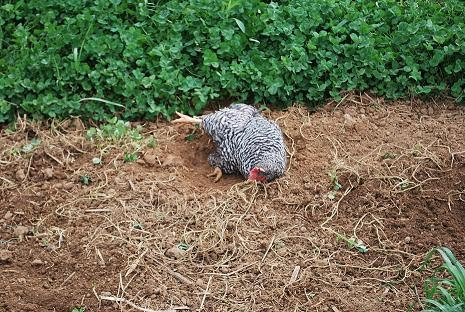
A chicken enjoys herself: a dust bath!

Wednesday, April 14, 2010

SHITAKE LOGS


Hi, this is Berea. Brian usually does the posting, but perhaps others of us will become more active. I am going to show you the shitake mushroom logs that we inoculated at the end of March.

Shitakes are one of those food items that are delicious to eat, expensive to buy, and simple to produce yourself. Take simple with a grain of salt, because I tried once before and failed completely. I inoculated during a drought year, 2005, and didn't soak my logs because I had heard it wasn't necessary. Well, now I'm pretty sure it's necessary, if the rains aren't coming your way. But I'm getting ahead of myself.

I first experienced fresh shitake eating at Sequatchie Valley Institute, in Tennessee. This is the place that all of us at Camp Pleasant have in common - I lived there a couple of summers before Adam, Brian, Melissa, and Sean all met there. It is a homestead that educates people about sustainable living systems. They had about 75 shitake logs leaned under some oak trees, next to a creek. In the mornings I would wander down to the shitake forest, cut some fresh shrooms off the logs, and saute up my breakfast with some eggs and greens. It was high class vegetarian eating. I also participated in a shitake log workshop there and inoculated my first logs. I vowed to have them in my life again. They appeal to me because they are low maintenance, last for years, and provide an intermittent supply of food - making them a good fit for a permaculture system.

Fast forward to Camp Pleasant. Although I hadn't planned on inoculating logs this spring.....It occurred to me one morning that our neighbor and friend, Mike Larimore, had some woods that might yield a couple of small white oak trees, which is a recommended type. It is also recommended to cut the trees before the leaves come out, so in early March the timing was right. For the exchange of 1/4 of our finished mushroom logs, Mike agreed. He and Sean went to his hill farm and hauled back two small white oaks, cut into 4 ft. lengths. Healthy trees are best because they will not already be colonized with other fungus, and it will take them longer to rot. Thinning out a young forest so that established trees can grow larger is a good reason to use some trees for mushroom logs.

Meanwhile, I ordered the mushroom spore and the needed implements from The Mushroom People. This is a small mushroom spore business located at The Farm, in Tennessee. Go to www.mushroompeople.com to check them out. Previously I had used "plug" spore, which are small cylinders of wood impregnated with the spore, that you tap into drilled out holes in the logs with a hammer. This time around I went with a method my neighbors Tim and Trina had been using, "sawdust" spore, which is inserted into the logs with a specialized plunger. It is supposed to be faster and cheaper than the plugs (marginally, I think). From the mushroom people I ordered 1 kg of strain MP510 spawn, which is a wide ranging variety that fruits within 6-9 months of inoculation and within a range of 55-80 degrees F. I also ordered two drill bit stoppers, and two pounds of cheese wax. These will be explained shortly.

The Mushroom People recommend inoculating the logs within three weeks of them being cut. After two weeks, on a drizzly late March Sunday, Brian, Melissa, and I set up two work stations and began. One was outside where we could drill the logs and scatter sawdust. The other was in the house close to the stove, to keep the cheese wax consistently melted. The process for inoculating goes like this: your logs should be cut to around four foot lengths, in diameters of 3-6 inches. This is so that you can easily the handle the logs as you move them around. Holes are drilled in the log to insert the spawn. For sawdust spawn, we used a 7/16 drill bit and set the depth of the bit to 1/2 inch, using the bit stopper. This is so you can move quickly and don't have to keep checking the depth of your holes. We drilled the holes beginning 3 inches down on the log, every six inches in a straight row until the end of the log. Then we moved over 2.5 inches and drilled another row of holes every 6 inches, staggering the holes so they were centered in between the holes of the first row. This gives the spawn maximum distance from the other holes. (Note: these specifics are all according to the directions given to us by The Mushroom People, and can be found easily on their website). When holes were drilled all around the log, it was ready to be inoculated.

In the kitchen, Brian and Melissa had tunes playing and were deeply concentrated on the inoculation process. When I brought them a log, first they would take the bucket of broken-up spore clumps and stab the plunger tool into it, so that it was packed in. We borrowed the plunger tool from our friends - thanks Tim and Trina! Then the plunger was lined up over a hole and compressed. If there was more spore than hole, we brushed it away so the spore was flush with the log. Then a dab of melted cheese wax was spread over the hole, to seal in the spore and seal out other fungi that might think it was a fine place to enter the log. The wax was kept in two double boiler pots that were always switched out so one could be re-melting.

While B and M inoculated, I went down to the spot we had selected for the logs to live and set up a water catchment system to soak them in. Our spot is in between a small storage shed and a steep cedar covered hillside. Evergreens are good to keep logs under because they will be constantly shaded. Melissa had seen mushrooms growing here before so we figured it was a friendly place for them. First I cleaned out the gutter on the roof; it was full of wet half-rotted leaves, which made a nice addition to the compost pile. Then I reconfigured the downspout to drain into a long steel watering trough, about 6 ft. long and 3 ft. deep. My plan for soaking the logs was to only have to carry them about six steps each way. This is important when handling heavy, wet logs.

Here is the finished result of our day's labor: 20 shitake logs, a shady place to keep them, and water tub to soak them. It has been two weeks and I have already soaked the second stack. The directions suggested soaking the logs every two weeks during the inoculation period, when the mycelium are taking over the log. This can last up to 9 months so I want soaking the logs to be as easy as possible. I'm already scheming about a larger catchment tank that will feed into the metal tub only when I'm ready to soak.....This way fresh water is always available for the soaking. The "used" soaking water is going on plants in the garden, so it has many uses before being returned to the water cycle.


This is the path through our Chickway garden. The shitakes are tucked between the shed and the hill at the bottom.


Here the logs are stacked log cabin style, to keep them off the ground and away from other fungi during the inoculation period


Close up of the log spot and water tank.


Soaking happily.

Wednesday, April 7, 2010

Drama Queens

This week, our bees arrived! A good friend, Mark Lee, is helping us along the way. He's a bee expert, an experienced tree farmer, and and all around fascinating, good guy. Melissa and Sean are doing a sort of partnership/apprenticeship: teaming up with him to keep bees at our place and our farm, process honey in Mark's certified kitchen, and help sell/trade the honey! Melissa met Mark while doing bee research for the University, and now their relationship has evolved to get us into the "beesniess". Oh, my.


Here Mark is helping Sean with the bee delivery. We got 5 hives for our Camp Pleasant land and 5 hives for the farm. They come in the small boxes that Mark has set in front of him, and they are then put into the frame boxes on the left.


Melissa dumps the bees into their new home! Some people might not believe it, but if you are calm and peaceful, the bees have no troubles with you and will not sting you.


Melissa, whose name literally means "bee", beams as she holds a small box with a queen bee.


And Sean shows off his favorite drone.

The bees at the farm were happily foraging on the fields of dandelion the next day. But some drama insued at Camp Pleasant, where one queen "escaped" from the hive and the swarm followed her! Melissa tries to find the queen, which is just a bit larger than the drones and worker bees:


When the queen is nowhere to be found in the box, its assumed that she is nestled on the crate, in a big pile of buzzing bees. Melissa tries to capture the pile of bees:


At this point the bees are a bit confused about what is going on, and buzzing wildly all around us. I had never been in anything like it! Its like you are in another world, ruled totally by the buzzing group movement that is the hive. Its really exhilerating.
When the attempt to move the queen didn't seem to work, the hive box was set right next to the little swarm, with hopes that the queen would enter the hive again and the drones and workers would follow:

Later in the day, Mark came over and helped move the queen into the hive, by hand. So far, so good: all the queens are home and safe, and the workers are out foraging the spring wildflowers and trees. Never a dull moment. . .!